

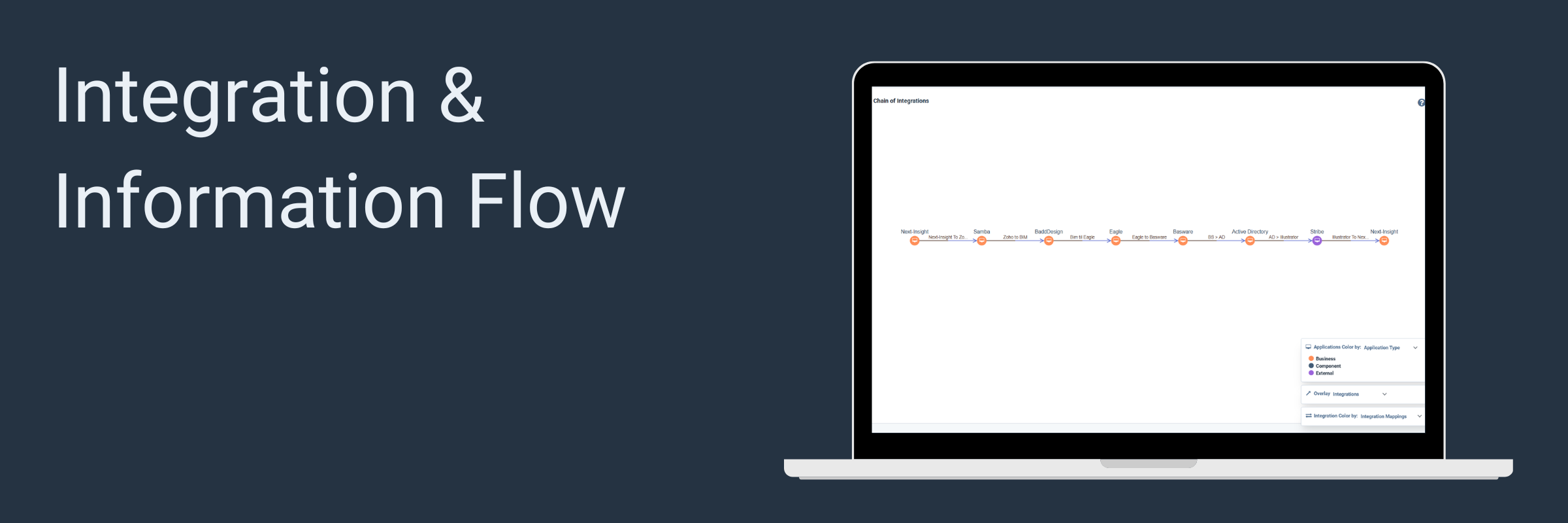
Integrations & Information Flow
Most organisations struggle to understand how information moves across their enterprise.
Business-critical information is often created in one system, enriched in another, transferred through multiple integrations, and ultimately consumed by a wide range of downstream applications and business processes.
Over time, organisations lose visibility into where information originates, where it is mastered, and how it flows across systems. As a result, duplicate data entry becomes commonplace, ownership becomes unclear, and organisations struggle to maintain data quality, compliance, and operational efficiency.
Many organisations believe they know where master data resides. In reality, information is often created and maintained in multiple places, making it difficult to establish a trusted source of truth. Without a clear understanding of information ownership, integrations and information flows, organisations face challenges such as:
Business Challenge
Most organisations struggle to understand how information moves across their enterprise.
Business-critical information is often created in one system, enriched in another, transferred through multiple integrations, and ultimately consumed by a wide range of downstream applications and business processes.
Over time, organisations lose visibility into where information originates, where it is mastered, and how it flows across systems. As a result, duplicate data entry becomes commonplace, ownership becomes unclear, and organisations struggle to maintain data quality, compliance, and operational efficiency.
Many organisations believe they know where master data resides. In reality, information is often created and maintained in multiple places, making it difficult to establish a trusted source of truth.
Without a clear understanding of information ownership, integrations and information flows, organisations face challenges such as:
- Duplicate registration of information
- Poor data quality
- GDPR and compliance risks
- Inefficient business processes
- Limited visibility across organisational silos
- Increased cost of change and transformation
At the same time, leaders need visibility into how information supports business operations, value streams and strategic objectives. Information governance is no longer a data management issue. It is a business management issue.
Key Capabilities
- Application Portfolio Management: Establish visibility into applications and their role in creating, maintaining and consuming information.
- Information Management: Create a structured catalogue of business-critical Information Objects and their ownership.
- Integration Management: Map the integrations that connect applications and exchange information across the enterprise.
- Information Flow Management: Understand how information moves across applications, processes and organisational boundaries.
- Master Data Governance: Identify where information is mastered and establish clear ownership of critical data.
- Value Stream Management: Connect information flows to value stream stages and understand how information supports value creation.
- Data Privacy & GDPR: Classify information according to confidentiality, criticality and regulatory requirements.
- Governance and Ownership: Assign accountability for Information Objects, integrations and information flows.
How Next-Insight Helps
Next-Insight enables organisations to establish complete visibility into how information is created, maintained, exchanged and consumed across the enterprise.
The platform provides out-of-the-box support for managing Information Objects, allowing organisations to establish a common catalogue of business information such as Customers, Employees, Assets, Contracts, Invoices, Claims or Products. Information Objects can be classified according to confidentiality, criticality and regulatory requirements, helping organisations understand which information requires additional governance and controls.
Each Information Object can be linked to the applications where information is mastered, maintained or consumed. Integrations are then established between applications, identifying source systems, target systems and the information exchanged between them.
Unlike many architecture and integration tools, Next-Insight elevates this understanding even further through Information Flows. Information Flows combine multiple integrations into end-to-end information journeys, showing how information moves across applications, processes and organisational boundaries.
This enables organisations to understand not only individual integrations, but also how information supports business execution from creation to consumption. Information Flows can be related directly to value stream stages, enabling organisations to visualise how information supports value creation from start to finish.
Because everything is managed through a structured and governed repository, ownership, accountability, criticality, confidentiality and compliance requirements can be assigned directly to information objects, integrations and flows.
The result is a practical and governance-ready foundation for information architecture, master data management, GDPR compliance and digital transformation.
Key Benefits
- Establish a Single Source of Truth: Create a reliable overview of Information Objects, ownership, applications and information flows.
- Strengthen Master Data Governance: Identify where critical information is mastered and establish clear ownership.
- Eliminate Duplicate Data Registration: Improve visibility into where information is created and maintained across systems.
- Improve Data Quality: Create transparency around information ownership, dependencies and data flows.
- Increase Transparency: Understand how information moves across applications, processes and organisational silos.
- Strengthen GDPR and Data Privacy: Improve visibility of information classification, ownership and regulatory requirements.
- Understand End-to-End Information Flows: Follow information from creation through integration and consumption.
- Enable Stronger Governance: Establish accountability for Information Objects, integrations and information flows.
How to Succeed Fast in Six Steps
Successful information governance initiatives should not start by attempting to document every application, integration and information flow. The most effective approach is to establish a strong foundation and gradually build visibility around the information that matters most. The following six-step approach will help you improve information governance across the enterprise.
1. Establish the Applications Portfolio Foundation
Start by creating visibility into your application landscape using Next-Insight’s Application Portfolio Management capabilities. This creates the governance foundation for understanding where information is created, maintained and consumed.
2. Map out Integrations
Identify and register the most important applications and the integrations that connect them. Focus initially on systems that are critical for operational delivery, compliance or transformation initiatives, and gradually expand from there.
3. Define Information Objects
Create a common catalogue of Information Objects and establish ownership, classification, confidentiality and criticality. This creates transparency regarding what information matters most to the organisation.
4. Map Information Flows
Register the Information Objects exchanged through integrations and establish Information Flows across the enterprise. Start with the most critical flows rather than attempting to document everything at once.
5. Establish Governance and Delegation
Assign ownership of Information Objects, Integrations and Information Flows. Create accountability for data quality, compliance and change management across the organisation.
6. Connect Information Flows to Business Outcomes
Link Information Flows directly to business processes and value stream stages. This provides complete end-to-end visibility from information creation to business execution and enables meaningful governance, compliance and transformation planning.
Related Use Cases
- Application Portfolio Management
- Business Process Management
- Value Stream Management
- Data Privacy & GDPR Management
- Enterprise Governance
Connect For More
Integration Management should be more than diagrams, spreadsheets and disconnected interface catalogues. Next-Insight helps organisations connect Information Objects, Integrations, Information Flows, Business Processes and Value Streams within a single governance platform.
The result is complete transparency into how information supports business operations, compliance requirements and digital transformation initiatives.
Book a demo today and discover how Next-Insight helps organisations understand where information is mastered, how information flows across applications, and how information supports business processes and value creation across the enterprise – Get a demo