

Enterprise Governance
Many organisations focus on collecting data, documenting architectures and building repositories before establishing governance. Yet the real challenge is rarely technology. The challenge is ownership.
Data catalogues, architecture repositories, diagrams and documentation often become the responsibility of a small group of architects and specialists. As organisations grow, knowledge becomes concentrated within a few individuals, while business stakeholders remain disconnected from governance activities.
As a result, organisations face challenges such as unclear ownership, declining data quality, siloed knowledge and limited business participation in architecture activities.
The challenge is not collecting information. The challenge is creating ownership, accountability and continuous participation across the enterprise.
Business Challenge
Many organisations focus on collecting data, documenting architectures and building repositories before establishing governance. Yet the real challenge is rarely technology. The challenge is ownership.
Data catalogues, architecture repositories, diagrams and documentation often become the responsibility of a small group of architects and specialists. As organisations grow, knowledge becomes concentrated within a few individuals, while business stakeholders remain disconnected from governance activities.
As a result:
- Ownership becomes unclear and data quality declines over time
- Knowledge becomes siloed and architects spend too much time maintaining documentation
- Business stakeholders see architecture as something owned by architects rather than by the organisation
The challenge is not collecting information. The challenge is creating ownership, accountability and continuous participation across the enterprise.
Key Capabilities
- Enterprise Governance: Establish governance structures, ownership and accountability across the organisation.
- Role-Based Ownership: Assign clear responsibility for applications, processes, capabilities, information and other architecture elements.
- Delegated Review Activities: Distribute governance activities to the stakeholders responsible for the information.
- Business Process Management: Connect architecture information with business processes and operational activities.
- Risk & Compliance Management: Extend the same governance model to risks, compliance requirements and controls.
How Next-Insight Helps
Next-Insight takes a data-driven Governance-First approach to Enterprise Architecture. Rather than focusing primarily on diagrams, modelling conventions and specialist architecture practices, the platform focuses on ownership, accountability, collaboration and decision-making.
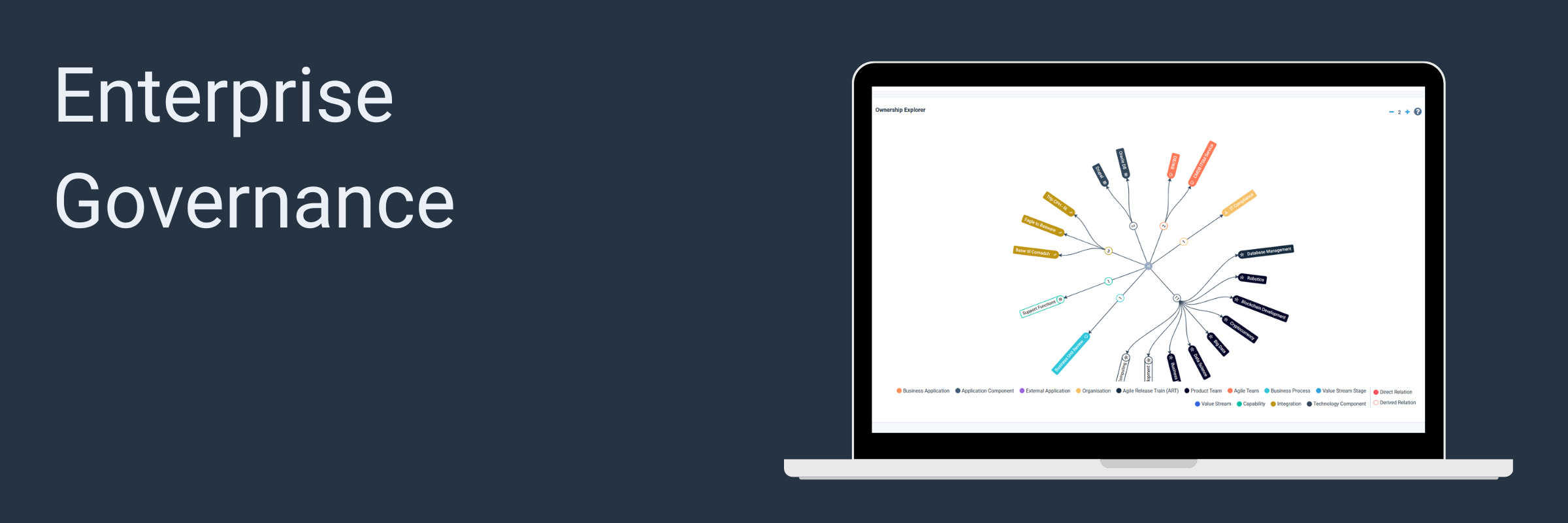
Every object within the platform can be assigned to responsible stakeholders, teams or organisational units. Applications, processes, capabilities, information objects, risks and initiatives can all have clearly defined and easily adjusted ownership and accountability.
This creates a governance model that distributes responsibility across the organisation rather than concentrating it within a specialist team of architects.
Because the platform is designed for business users as well as architects, stakeholders can contribute directly to the information they own. This improves data quality while reducing dependency on specialist resources.
Governance workflows support reviews, approvals, quality assurance and continuous improvement. Risk management, compliance activities and quality management initiatives can leverage the same governance model, ensuring consistency across the practice.
Unlike traditional architecture repositories that often become documentation exercises, Next-Insight helps organisations establish Enterprise Architecture as an operational management capability that integrates with processes performed by the business.
Architecture becomes less about documenting the organisation and more about governing it.
Key Benefits
- Establish Clear Ownership: Assign responsibility for architecture information across business units, teams and individual stakeholders.
- Improve Accountability: Make ownership and responsibilities visible across the organisation.
- Increase Stakeholder Engagement: Enable business stakeholders to actively participate in maintaining and improving the information they own.
- Improve Data Quality: Move responsibility closer to the source of knowledge and reduce dependency on specialist teams.
- Increase Organisational Transparency: Create a shared understanding of architecture, ownership and business dependencies.
- Turn Architecture into a Management Discipline: Move beyond documentation and make architecture part of governance and decision-making.
How to Succeed Fast in Six Steps
Successful Enterprise Architecture initiatives should not start with collecting large amounts of information. The most effective approach is to establish ownership and governance first, then gradually distribute responsibility across the organisation. The following six-step approach will help you establish a more collaborative and sustainable governance model.
1. Establish a Governance Foundation
Start with the standard governance capabilities available out-of-the-box in Next-Insight. Define ownership principles before collecting large amounts of information. This creates a strong foundation for sustainable governance.
2. Define Roles and Responsibilities
Assign clear ownership to business units, application owners, process owners and other key domains. Focus on responsibility for maintaining and updating information for each element type from the beginning.
3. Extend Gradually
Establish a shared roadmap for extending governance to other element types within the architecture. For each domain and element type, ensure responsibilities are clearly defined within the platform.
Governance starts when everyone can see accountabilities and contribute to maintaining the information they are responsible for.
4. Delegate to Owners
Allow stakeholders to maintain and improve the information they own. Give them easy access to enrich data, update information and contribute to new properties and knowledge. Move responsibility closer to the source of knowledge within the business.
5. Establish Reviews and Workflows
Introduce governance processes for approvals, reviews and compliance checks to support continuous improvement. Activate built-in workflows to reduce the workload for architects and make governance part of the operating model rather than a separate exercise.
6. Expand Governance Across the Enterprise
Extend ownership and accountability across all relevant element types in the Next-Insight solution so that applications, processes, information, risks, initiatives and value streams are all supported by workflows and delegated governance.
This creates a sustainable governance model that grows naturally with organisational maturity.
Connect For More
Governance should be more than policies, diagrams and documentation. Next-Insight helps organisations establish ownership, accountability and collaboration across processes, applications, information, risks and strategic initiatives through a Governance-First approach.
The result is better decisions, stronger compliance, improved transparency and a more sustainable Enterprise Architecture practice.
Book a demo today and discover how Next-Insight helps organisations turn governance into action through ownership, delegation and collaboration – Get a demo